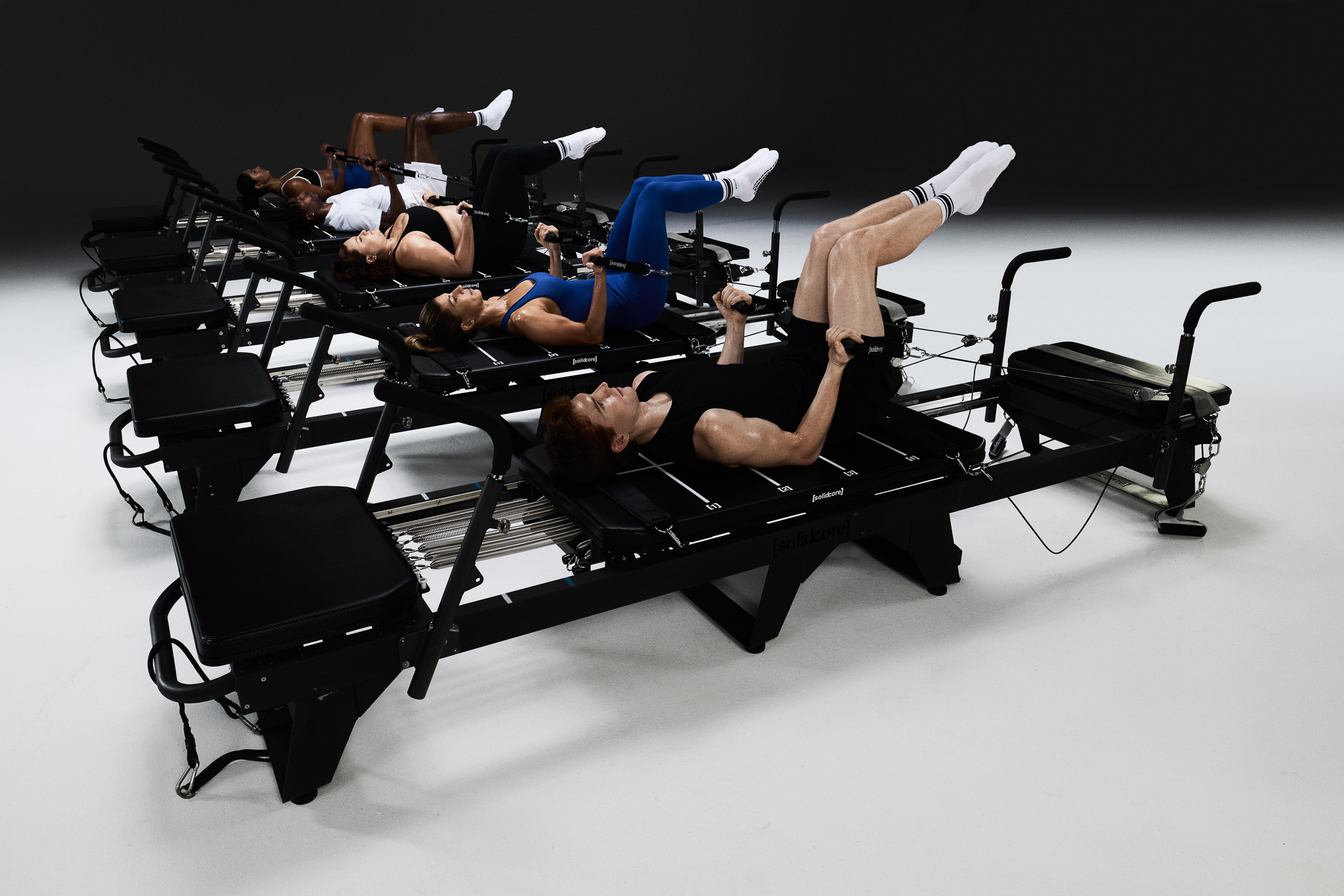
A high-intensity, low-impact workout, often shortened to HILIT, pushes your muscles and cardiovascular system hard without jumping, bounding or pounding on your joints. Intensity comes from resistance, tempo, time under tension or short rest instead of from impact. At [solidcore], that means a 50-minute, coach-led strength class on a custom-built reformer, where slow, controlled movement under spring resistance takes each muscle group to failure and your feet never leave the machine.
What high-intensity, low-impact actually means
The phrase joins two separate measures of a workout.
- Intensity is how hard your body works. In cardio it is tracked by heart rate. In strength training it is how close each set gets to muscle failure.
- Impact is the force that lands on your joints. High-impact moves such as jumps, sprints and burpees send a landing force through your ankles, knees, hips and spine on every rep. Low-impact moves keep you in contact with the floor or the machine, so there is no landing.
A workout can be low-impact and very hard at the same time. As Cleveland Clinic exercise physiologist Katie Lawton explains, low impact is not about effort; the difference is how much stress the activity puts on your joints. That combination is the whole point of HILIT.
HILIT vs. HIIT
HIIT (high-intensity interval training) and HILIT share the word intensity and not much else.
- What drives intensity. HIIT: bursts of near-max effort, traditionally 30 to 90 seconds at around 85 percent of max heart rate, followed by rest. HILIT: resistance, slow tempo, time under tension, and short or no rest between exercises.
- Impact on joints. HIIT: often high, because most HIIT programs include jumping and sprinting. HILIT: low by definition. No jumping.
- Pace. HIIT: fast and explosive. HILIT: slow and controlled, or steady and continuous.
- Main adaptation. HIIT: cardiorespiratory fitness and calorie burn in a short session. HILIT: muscular strength and muscular endurance, with a heart rate response that is real but lower than a sprint interval.
- How you scale it. HIIT: change the work-to-rest ratio or swap in low-impact moves. HILIT: adjust the resistance (at [solidcore], the spring load) and take the modification or amplification your coach cues.
- Who it fits. HIIT: people who want short, cardio-driven sessions and tolerate impact. HILIT: people who want a hard strength workout with less joint stress, including runners who cross-train, beginners and, with a doctor's clearance, people returning to exercise after an injury.
One honest note. Because HILIT builds intensity through muscle tension rather than sprinting, your heart rate will climb but it will not spike the way it does in a HIIT class. If you track workouts on a wearable, expect the strain score to read lower than the effort feels. The shaking is the better gauge.
Two ways to make a workout intense without impact
Most fitness coverage of HILIT describes the first. [solidcore] is built on the second.
- Interval-style HILIT keeps the HIIT structure (work, rest, repeat) and swaps the jumps for low-impact moves: squats instead of squat jumps, step-ups instead of box jumps, push-ups instead of burpees. Heart rate is still the main driver.
- Resistance and time-under-tension HILIT drops the interval clock and makes each exercise slow, loaded and continuous. Intensity comes from how long the muscle stays contracted and how close you get to failure, not from speed. This is a strength workout first.
Research supports the second route. In a McMaster University study, lifting a light load slowly until fatigue produced a larger and longer-lasting rise in muscle protein synthesis than lifting the same light load at a normal pace. A 2016 study in the Journal of Applied Physiology found that in trained men, the weight lifted did not determine muscle growth as long as every set was taken to failure. You do not need heavy weights or jumping to build muscle. You need tension and effort.
How a high-intensity, low-impact workout works at [solidcore]
Every [solidcore] class is a 50-minute, full-body, high-intensity, low-impact strength workout on a Pilates-inspired reformer. Here is where the intensity comes from.
- Resistance, not impact. The machine's adjustable spring loads supply the load, so you scale resistance to your strength and experience. Nothing in class asks you to jump.
- Slow, controlled movement. Every exercise is performed slowly and with control to keep the target muscle contracted through its full range of motion. Moving slowly means more metabolic work per second, because fast reps use momentum and let the muscle rest partway through.
- Time under tension to failure. Reps are consecutive, with no breaks inside an exercise, so the muscle stays under tension until it reaches failure. That is when the shakes start.
- Full body, every class. Each class trains core and obliques plus one lower-body and one upper-body muscle group from the monthly muscle focus calendar. Across a month, every major muscle group gets its turn.
- Small classes, individual cues. Class sizes are small, and coaches cue a modification (a more supported version of the move) or an amplification (a harder version) throughout class. Two people on neighboring machines can do the same exercise at different intensities.
- A format for every level. Starter50 opens with a machine tutorial and builds in programmed rest between muscle groups. Signature50 removes the programmed rest. Advanced50 adds harder transitions and amplified exercises. Here is how to pick your first class.
[solidcore] trains for muscular endurance, the ability to keep working against resistance without fatiguing, rather than the one-rep strength you build lifting heavy at the gym. Both matter. This one is the strength you use all day, which is why it supports running, lifting and every other sport so well.
How to choose a high-intensity, low-impact studio
Use this checklist when you compare studios, including ours.
- Ask where the intensity comes from. A good answer names resistance, tempo, time under tension or interval structure. "It's low impact" on its own is not a method.
- Ask how it scales. Can resistance and moves be adjusted for your level, and does the coach cue options during class rather than only before it?
- Look for a beginner path. An intro class or machine tutorial before your first full session shortens the learning curve.
- Ask about class size. Smaller classes mean more form corrections, which matter more in slow, loaded movement than in fast cardio.
- Confirm it is full body. Over a week, classes should cover core, lower body and upper body, not the same two muscle groups every day.
- Look for planned programming. A published muscle focus or rotation means progression is built in and overtraining one area is designed out.
- Ask how coaches handle injuries and returns to exercise. There should be a clear answer on modifications, and you should check with your doctor or physical therapist first if you have an injury or a condition. Here is how [solidcore] approaches injury recovery.
- Check the practical fit. Locations, schedule and an intro offer decide whether you actually show up. Find a studio near you.
Try a high-intensity, low-impact class
Book a Starter50 at your nearest studio, or start with the New Client Two Week Unlimited offer to try several coaches and formats in your first 14 days.
FREQUENTLY ASKED QUESTIONS
What does high-intensity, low-impact mean? ➜ It describes a workout that works your muscles and cardiovascular system hard while avoiding jumping and other movements that send a landing force through your joints.
What is HILIT? ➜ HILIT stands for high-intensity, low-impact training. It covers any workout that builds intensity without impact, whether through low-impact intervals or through resistance and time under tension.
Is HILIT the same as low-impact HIIT? ➜ Low-impact HIIT is one kind of HILIT: it keeps the interval format and swaps out the jumps. [solidcore] is the other kind. It builds intensity through resistance, slow tempo and time under tension rather than intervals.
Is a low-impact workout really hard? ➜ It can be. In a [solidcore] class, each exercise continues until the target muscle reaches failure, which is why people shake and sweat with no jumping at all.
Is [solidcore] a HILIT workout? ➜ Yes. [solidcore] is a 50-minute, high-intensity, low-impact, full-body strength workout on a Pilates-inspired reformer.
Is [solidcore] Pilates? ➜ No. [solidcore] uses a Pilates-inspired reformer, but it is a strength-training workout focused on resistance and slow, controlled movement rather than the deep breathing central to Pilates.
Does a HILIT workout raise your heart rate? ➜ Yes, though less sharply than a sprint interval. The intensity in a resistance-based HILIT class is muscular, so wearables often read lower strain than the effort you feel.
Can beginners do HILIT? ➜ Yes. [solidcore]'s Starter50 includes a machine tutorial, slower transitions and programmed rest, and coaches cue spring loads by experience level.
Is HILIT safe after an injury? ➜ Low-impact resistance training is often used while recovering from an injury, and [solidcore] coaches can modify exercises around one. Get your healthcare provider's clearance first and tell your coach before class.
How long is a [solidcore] class and what does it work? ➜ 50 minutes, covering core, obliques, one lower-body muscle group and one upper-body muscle group. Power30 formats run 30 minutes and Advanced65 runs 65.
How often should I do HILIT? ➜ If [solidcore] is your main workout, aim for 4 to 5 classes a week on non-consecutive days. If you pair it with running, lifting or other training, 2 to 3 a week works. Beginners can start at 1 to 2 and build up. Either way you clear the CDC's baseline of muscle-strengthening activity on 2 or more days a week.






 Your Privacy Choices